

Every year, enterprise organizations bleed thousands of dollars on software auto-renewals. Whether it’s an unused seat license or a platform your team abandoned six months ago, missing a cancellation window is a costly operational failure.
While financial controllers and IT managers often turn to incredibly expensive, dedicated SaaS management platforms to solve this, there is a much more efficient alternative. By building a customized Notion contract management system, you can track expensive software subscriptions in a lightweight, flexible environment.
But there’s a catch. While Notion is a stellar repository for static data, it fundamentally lacks the aggressive, chronological alerting necessary to notify stakeholders 30, 60, or 90 days before a critical deadline.
In this guide, we’ll show you exactly how to logically structure a relational contract database within Notion and how to pair it with automated alerts to secure 100% compliance on your renewals.
The Hidden Cost of Missed SaaS Renewals
The transition to cloud-based software has made procurement incredibly decentralized. When department heads can swipe a corporate card to spin up a new tool, the centralized IT and finance teams lose visibility into the company's SaaS stack.
Why spreadsheets fail for IT managers
Many teams attempt to track these sprawling contracts in static spreadsheets. Spreadsheets are passive. They require a human to remember to open the file, check the dates, and cross-reference them with the current calendar. In a fast-moving enterprise, relying on human memory to track legally binding cancellation windows is a recipe for budget bloat.
The trap of expensive dedicated platforms
To combat this, operations directors often purchase dedicated SaaS management platforms. While these tools offer robust alerting, they come with astronomical price tags and implementation periods that can take months. You end up paying a premium for a complex platform when all you really needed was a database and a reliable calendar ping.
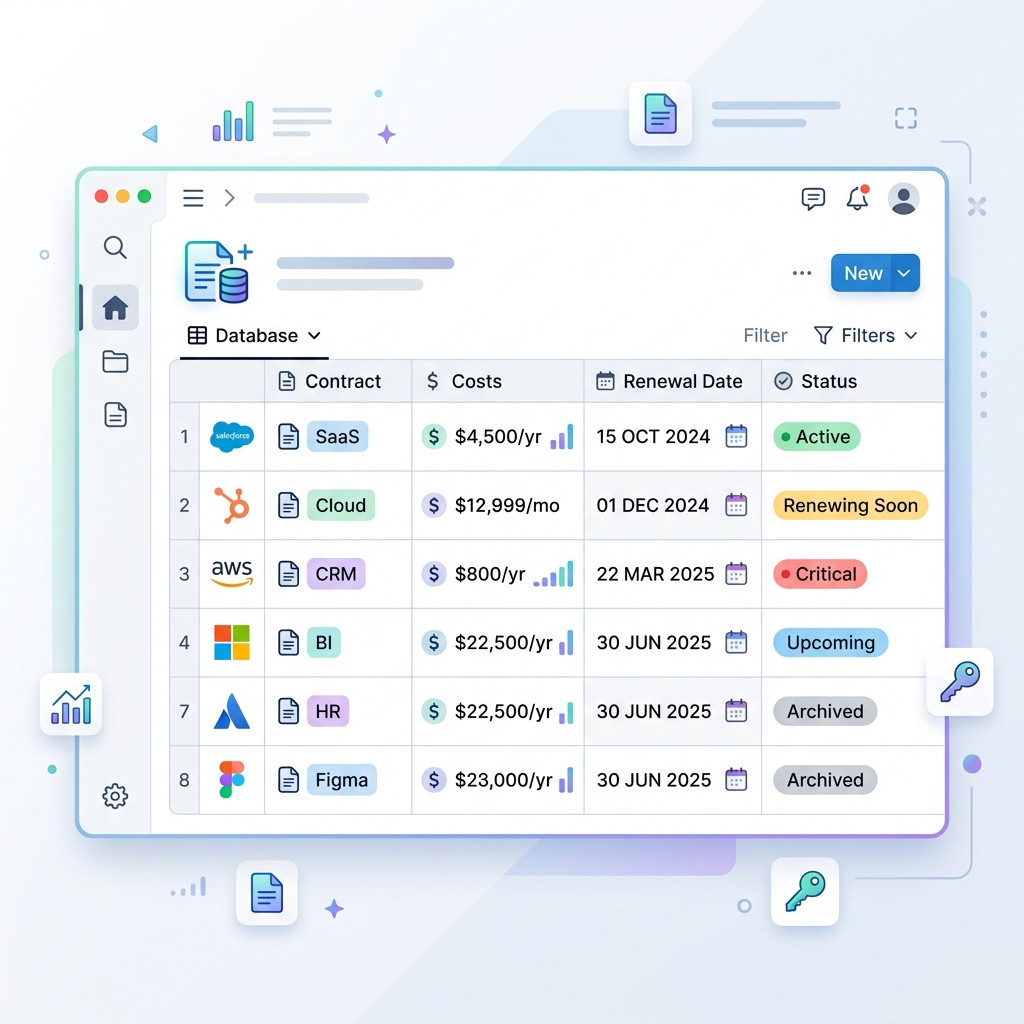
Structuring a Relational Notion Contract Management Database
Notion provides a highly valuable, free framework for organizing your vendor relationships. By creating a relational database, you can map every software subscription to its respective internal owner.
Core properties: Vendor, Cost, and Renewal Date
To build your Notion CRM setup for contracts, start with a centralized database containing these essential properties:
- Vendor Name: (Title) The name of the software.
- Annual Cost: (Number) The total financial commitment.
- Renewal Date: (Date) The exact day the contract auto-renews.
- Cancellation Window: (Number) How many days' notice the vendor requires to cancel.
- Status: (Select) Active, Under Review, or Cancelled.
Linking to internal stakeholders
Use a Relation property to link each contract to a "Team Directory" database. This explicitly defines the internal owner, the specific Account Executive or IT manager responsible for utilizing the software. This relational structure transforms a simple list into a dynamic operational hub.
The Fatal Flaw: Notion's Native Alerting Architecture
You’ve built a pristine contract repository. The data is structured, and the owners are assigned. But if you rely solely on Notion to manage the renewal lifecycle, you will fail.
Event-driven vs. Chronological triggers
Notion is fundamentally incapable of aggressively alerting financial stakeholders based purely on the passage of time. Its native automations are strictly event-driven. This means Notion will only trigger a webhook or notification if a user actively edits a page or changes a status.
When a critical renewal deadline is simply approaching on the calendar, 30, 60, or 90 days out, the database stays completely silent. Relying on Notion’s native architecture leaves you blind to catastrophic financial risks quietly approaching in your workspace.
Adding Automated Renewal Alerts to Your Notion Setup
To bridge this gap, teams often build complex Zapier or Make flows. However, these heavyweight middleware solutions break silently the moment a database column is renamed.
Instead of paying the extreme cost of a dedicated SaaS management platform or relying on brittle workarounds, the most efficient solution is pairing your Notion setup directly with NotionReminder.
Replacing Zapier with single-purpose polling
NotionReminder is a deterministic chronological alerts engine. It securely polls your Notion databases in the background, specifically looking for those passive date properties. You can set exact mathematical rules, like "alert me 90 days before the Renewal Date", and it handles the rest without unpredictable AI credit consumption.
Delivering targeted Slack messages to stakeholders
When a threshold is met, NotionReminder dynamically translates your database properties into beautifully formatted Slack Block Kit messages or HTML emails. It routes these alerts directly to the @mentioned stakeholder, ensuring that the IT manager or financial controller has ample time to negotiate or cancel the contract.
FAQ
Can Notion send automated reminders for contract renewals?
Notion's native reminders only notify you in-app on the exact date or require manual, per-item setup. To get automated, external alerts (like a Slack message 60 days before a renewal) across an entire database, you need a deterministic polling engine like NotionReminder.
Is it secure to store SaaS contracts in Notion?
Yes, Notion offers robust enterprise-grade security and granular permission settings. You can restrict access to your contract management database so only authorized operations directors and financial controllers can view sensitive pricing data.
How do I calculate the ROI of a Notion contract management system?
Calculate the total cost of any auto-renewed software your team did not intend to keep over the past year. Compare that lost budget against the minimal cost of a Notion workspace and a NotionReminder subscription. The ROI is typically realized after preventing a single missed renewal.
Conclusion
Building a custom Notion contract management system gives you the flexibility of a tailored operational hub without the bloated cost of dedicated enterprise platforms. However, structured data is only half the battle.
To achieve true operational autonomy, you must pair your database with reliable, chronological alerting. Time is the one variable you can't control, but it's the one you must track.
Start your free trial of NotionReminder today, and never miss a critical Notion deadline again.
